Many AI projects fail for one simple reason: the model does not know the business.
It may have billions of parameters, but if it does not understand your customers, contracts, processes, and permissions, it will keep responding like a sophisticated search engine. And with more room to make things up: when it does not have the right data at hand, it fills in the gaps however it can, and that is where hallucinations appear.
That is why Microsoft IQ was, for me, one of the most important announcements from Build 2026. It is the intelligence layer Microsoft introduced as the brain behind Copilot and the agents every company builds on its own.
If I had to summarize it in a single sentence for a technology leader, it would be this: anyone will have access to the model; your context is what they will not have, and Microsoft IQ is the way to turn that context into your advantage.
In 30 seconds
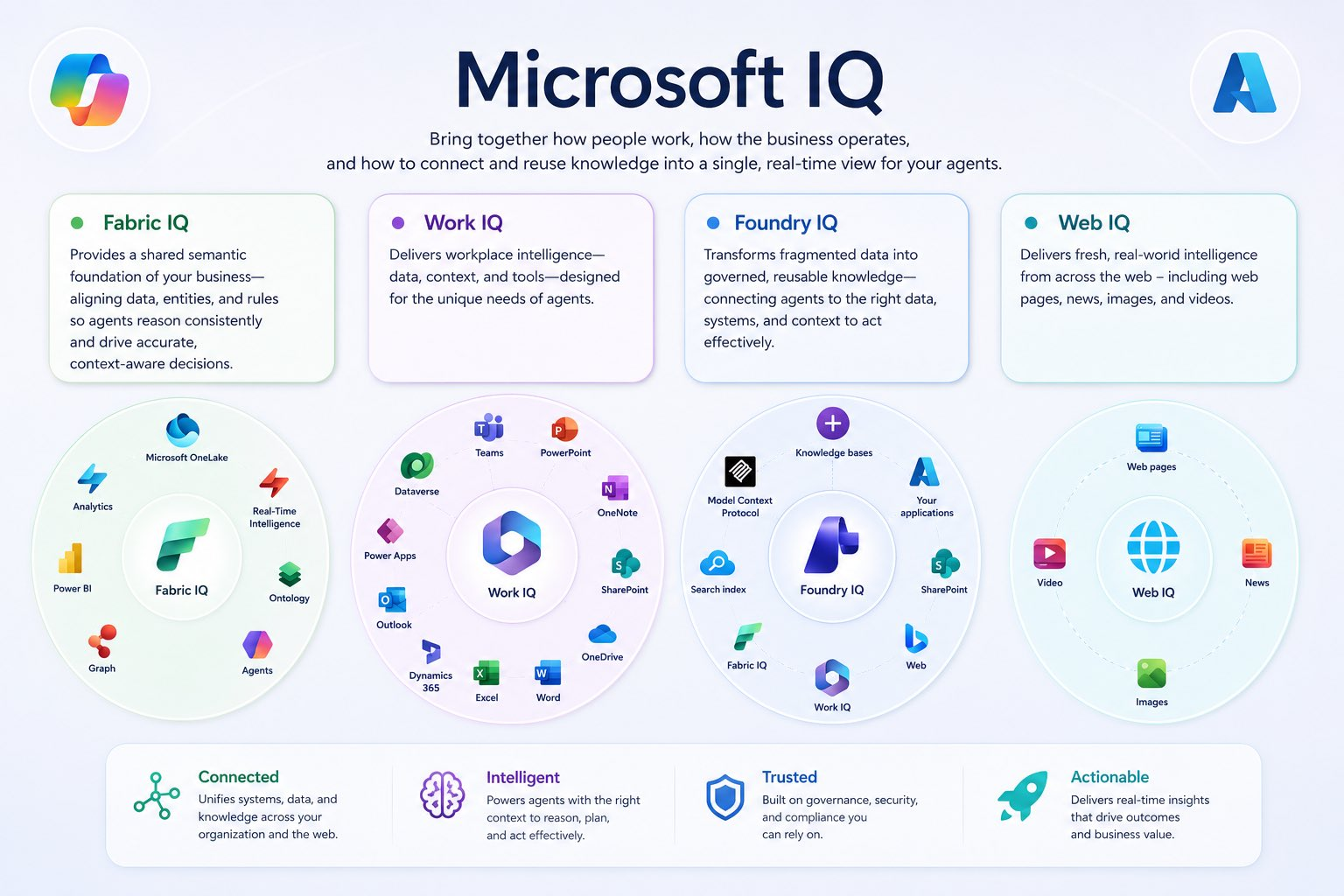
What is interesting is that it tackles a problem we see repeatedly in enterprise AI projects: the knowledge exists, but it is scattered across systems, documents, and conversations. It does this by combining four intelligence domains:
- Work IQ → work and collaboration in Microsoft 365
- Fabric IQ → structured business data
- Foundry IQ → unstructured institutional knowledge
- Web IQ → real- time information from the web
The goal is not to give the model more data, but to give it only the right data.
The problem
Before IQ, building a useful agent on top of company data was a handcrafted project. The knowledge was there, but scattered across emails, contracts, data models, and a thousand conversations. Connecting it meant manual integrations, with the risk of ending up sending too much context, too little context, or outdated context. On top of that, the usual question remained: am I letting it see data it should not see?
One phrase came up repeatedly at the event: agents win or lose on context. Context is the moat, the defensive advantage that competitors cannot easily copy. Your information and the way your people work are what no one else has. If you organize that layer, you have something defensible. If you do not, you will be running the same race as everyone else with the same old model.
How Microsoft solves it
Microsoft’s answer is to organize all of that context into four domains that connect with each other.
Work IQ understands how work happens inside Microsoft 365: emails, files, meetings, chats, the people graph, and collaboration patterns – who you work with, on which projects, and how often. The real day-to-day, while respecting each user’s permissions. The important part is that it is no longer exclusive to Copilot: any agent can rely on Work IQ. It has just reached general availability and is billed based on consumption.
Fabric IQ brings in business data through Microsoft Fabric – OneLake, semantic models, Power BI, real- time analytics, and ontologies. The point is that the agent reasons over customers, orders, or inventory as entities, not as tables. You move from “query this column” to “tell me which customers are at risk.”
Foundry IQ is the layer for institutional knowledge: contracts, policies, official documents, and unstructured content, from PDFs to JSON and XML. It organizes and indexes that knowledge to retrieve only the relevant fragments and avoid sending the model more information than it needs. It connects with OneLake, Azure SQL, and MCP servers, so you can also bring in knowledge from internal systems such as Salesforce or ServiceNow.
Web IQ lets responses be enriched with recent information from the web. It is based on Bing’s global index, but designed for how an agent searches, not how a person searches: instead of returning the entire page, it gives the agent the exact fragment it needs, quickly and without wasting tokens.
What Microsoft already has ready: Work IQ is already available in GA, there is a consumption-based pricing model, you pay for the work it does, not for a flat license – semantic reranking capabilities to return only what is most relevant, and MCP connectivity to add knowledge from internal systems. The typical use case is clear: an agent that, when asked “prepare the account summary for this customer”, brings together emails and meetings through Work IQ, orders and inventory through Fabric IQ, the active contract through Foundry IQ, and a recent industry news item through Web IQ, all while respecting what that person is allowed to see.
And if you give it that much information, does the context not get overloaded?
The short answer is no, because the model never receives everything. Four data sources may sound like forcing half the company into the prompt, but the design does exactly the opposite: out of all that information, the model only receives the pieces that matter for the question at hand.
The trick is in what happens before the model is called. Each source is indexed first, whether it is a PDF, a JSON file, or a table. When a query comes in, instead of reading everything, the system searches in two ways at once. On one side, vector search looks for meaning: it converts text into embeddings and finds what is conceptually similar, even if it does not use the same words. On the other side, lexical search looks for exact keywords, which is ideal for codes, product names, or contract numbers. Combining both – hybrid search – is what produces a strong list of candidates.
Then the semantic reranker comes in on top of those candidates, reorders them, and keeps only the highest-quality ones. Web IQ does the same with the web: it returns the specific section of the document or site, not the entire page.
The result is that the model receives relevant fragments, not the full collection. You give it just enough to solve the problem well, without confusing it and without using unnecessary tokens.
Beyond RAG
Although it uses retrieval and grounding techniques, the proposal goes beyond traditional RAG. It incorporates structured knowledge based on entities and relationships, not just text retrieval. It allows agents to maintain context across long workflows. And governance is built in: permissions, security, and compliance, so the agent receives what it is allowed to see and nothing more. That is usually what slows down serious projects. Almost no one doubts that AI is useful. What they doubt is whether they can trust what it does with their information.
A shift in mindset
It is easy to obsess over choosing the best model. But the model is becoming almost interchangeable, and the work that truly moves the needle sits higher up, in the context layer.
In the age of agents, the strategic asset is the ability to turn data into useful context. Models will increasingly start to look alike. Your organization’s context will not. And Microsoft IQ is a clear bet that this difference is where value will be created.
The technology reduces much of the technical complexity, but organizing knowledge, defining permissions, and establishing governance policies remain the work of each organization.