



Cybersecurity threats are evolving, fast. From advanced phishing schemes to AI-driven malware, attackers are scaling their efforts with new levels of speed and precision. To keep up, security teams are looking at examples of AI in cybersecurity for their use cases.
“In the second half of 2024, there was an 202% increase in phishing attacks. AI’s role in cybersecurity is expanding for good reason,” said Jacob Saunders, EVP of Professional Services, Atmosera.
“With billions of devices generating massive amounts of data, manual monitoring simply isn’t enough. AI enables organizations to process this data in real time, detect patterns humans would miss, and respond to risks before they escalate.”
In this blog post, we’ll break down the top ways AI is being used in cybersecurity today, from real-time threat detection to automated code analysis, so you can see where these tools add the most value and where human oversight still matters.
How Can AI Be Used in Cybersecurity?
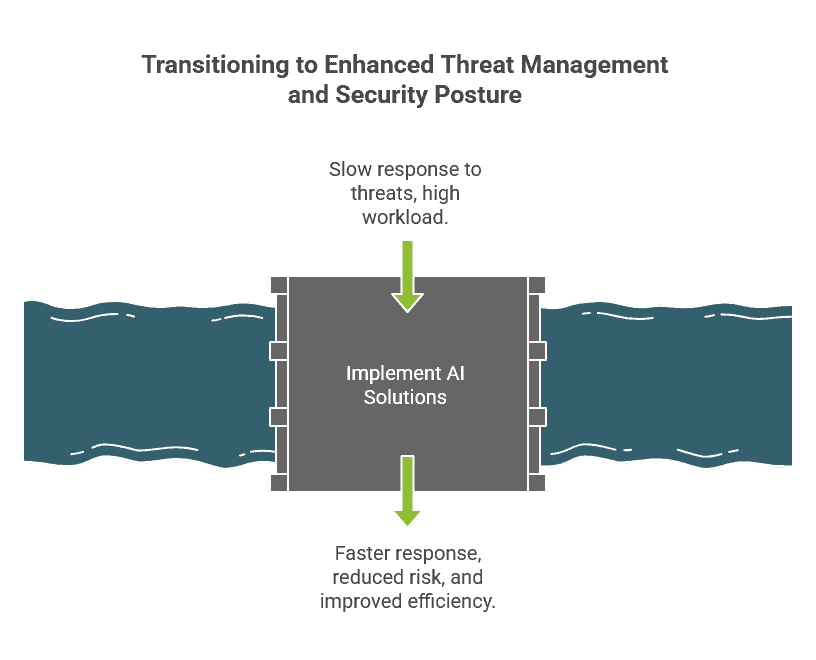
One of the clearest examples of AI in cybersecurity is its ability to streamline how your team detects, understands, and responds to threats.
1. Proactive Threat Intelligence
With AI-assisted threat intelligence, you can pull from a broad range of sources to uncover evolving tactics, emerging malware, and known vulnerabilities. The result? Your security team gains clean, usable insights to shape policies, refine defenses, and stay ahead of attackers, without spending hours sifting through raw threat feeds.
2. Smarter Anomaly Detection
AI tools are highly effective at flagging irregular behavior across logs, systems, or user sessions. By continuously analyzing baselines, like API traffic, login frequency, or internal data transfers, AI models can spot and escalate outliers in real time.
This allows you to act fast when something doesn’t look right. Even better, AI can group and prioritize alerts by severity, cutting down on overload and helping your team focus on what actually matters.
3. Automated Vulnerability Discovery
Testing doesn’t stop at deployment, and AI is changing how application security teams approach it. AI-powered dynamic testing tools can simulate common attack paths on running applications without requiring manual setup. This makes it easier and faster to find potential weak points, freeing your team to focus on critical fixes.
4. Code Security with AI Assistance
Secure code is your first line of defense. AI is already integrated into modern development workflows to help catch mistakes early. Today’s intelligent tools can scan source code, infrastructure as code (IaC), and even live environments for risky patterns. They understand context, which helps reduce false positives and eliminate guesswork during remediation.
| Learn how you can further safeguard your enterprise’s infrastructure, data, and more: |
Top 10 AI Use Cases in Cybersecurity
Artificial intelligence is driving a major shift in how cybersecurity teams detect threats, manage risks, and close vulnerabilities. These AI-driven use cases show how organizations like yours can respond faster, reduce overhead, and stay ahead of increasingly complex attack strategies.
1. Real-Time Threat Detection
One key use of AI in cybersecurity? Threat detection.
Currently, SOCs take in an average of 3,832 security alerts every day. AI tools are built to detect suspicious behavior that slips past static rules. If it’s subtle changes in network activity or unusual patterns in endpoint logs, AI can quickly flag behavior that doesn’t belong.
By analyzing massive datasets and learning from past events, AI models identify risky behavior that might otherwise go unnoticed, and they do it without flooding your team with noise. Instead of reacting late, you get visibility into threats as they emerge.
2. Intelligent Alert Management
Your team shouldn’t spend half the day digging through irrelevant alerts. AI filters out the clutter by assessing context, severity, and potential business impact. That means fewer false positives and smarter prioritization. As a result, your team can focus on the threats that matter most.
The outcome? Faster response times and less time wasted on low-impact issues.
3. Tackling Alert Fatigue with Agentic AI
Alert fatigue is a persistent challenge for every cybersecurity team. With thousands of alerts flooding dashboards daily, distinguishing real threats from noise can overwhelm even the most seasoned analysts.
Enter Agentic AI, a transformative class of artificial intelligence designed to operate autonomously, purposefully, and adaptively. These systems aren’t just reactive; they possess agency, meaning they can make decisions, take action, and learn from outcomes in dynamic environments without constant human oversight.
By deploying AI-powered agents, security teams can offload high-volume, repetitive, and complex tasks. These agents continuously monitor, triage, and respond to threats, freeing up human analysts to focus on strategic initiatives and high-priority incidents. The result? A smarter, faster, and more resilient security posture.
4. Smarter Vulnerability Management
20% of data breaches in 2025 have resulted from the exploitation of system vulnerabilities. AI takes the guesswork out of identifying which vulnerabilities need to be patched first. These tools predict which weaknesses are likely to be exploited based on historical data, code dependencies, and emerging attack trends.
Then, they trigger patch workflows automatically. The result is a tighter, more agile security posture, with fewer gaps and less risk of delayed remediation.
5. Reinforcing Password Security with LLMs
One of the more recent examples of AI in cybersecurity, large language models (LLMs), are changing the way cybersecurity teams are handling password security. Attackers are using AI to break weak passwords in seconds, but that same technology can also help strengthen them.
LLMs trained on real-world password leaks can evaluate password strength more effectively than traditional rule-based tools. These models are also being used to generate strong, unpredictable passwords that don’t follow common patterns.
This means better tools for enforcing secure password practices and fewer weak links in user authentication.
Unlock Real Results with AI-Driven Cybersecurity
Protect your cloud, data, identity, and AI initiatives with tailored security solutions from Atmosera.
6. Smarter Patch Deployment
Outdated systems are still one of the top causes of data exposure. AI-powered cybersecurity also includes patch management solutions. These help close that gap by automating the detection and remediation process.
These tools can assess vulnerability severity, identify system dependencies, and suggest the right sequence for patch rollout, all with minimal manual oversight.
Some platforms are already experimenting with AI-generated fix recommendations, helping developers resolve security flaws even faster.
7. Automated Risk Analysis
Evaluating risk across your environment doesn’t need to be slow or subjective. AI can digest known threats, business context, and historical incidents to produce actionable risk assessments in a fraction of the time. These tools provide deeper clarity on which risks matter most, how they could impact operations, and which mitigation steps are most effective.
Instead of building reports from scratch, your team gets immediate visibility into risk posture.
8. Supercharging SecOps with AI
Security teams often spend their day buried in logs, alerts, and manual workflows. AI helps ease that load. Whether it’s parsing threat intel, summarizing investigations, or answering natural-language queries, AI can drastically cut down the time spent on research and onboarding.
Analysts can use conversational inputs instead of memorizing platform-specific query languages, helping new team members ramp up faster. Some platforms now deliver real-time summaries of threat actors, investigation details, and incident context, saving hours without sacrificing depth.
9. Catching Deepfakes Before They Cause Damage
One unexpected example of AI in security? Catching deepfakes.
Synthetic media is now a real threat vector. Attackers are using voice clones and AI-generated video to impersonate executives and trick employees. In response, AI-based detection tools are stepping in to flag signs of manipulation.
These tools analyze voice patterns, facial movements, and inconsistencies that the human eye might miss. Forward-thinking organizations are even running simulation environments to test their deepfake defenses under real-world pressure.
10. Automating the Help Desk
Password resets, access permissions, and multi-factor prompts eat up more time than they should. AI-based assistants are now handling these repetitive identity and access tasks automatically. Available around the clock, they respond to user requests instantly, reduce bottlenecks, and help your security staff stay focused on high-priority threats.
For companies looking to improve both user experience and security posture, automating the help desk is a high-impact first step.
Limitations of AI in Cybersecurity
While AI is transforming how security teams operate, it’s not a silver bullet. Like any technology, it has boundaries, and in some cases, it can introduce new risks. Here’s where AI needs close oversight and a strong human hand on the wheel.
1. Manipulated Models
AI systems can be compromised long before they’re deployed. Attackers may tamper with training data to influence model behavior, or craft inputs that trick the model into making the wrong call. This kind of manipulation, known as model poisoning or adversarial input, can weaken threat detection and create false trust in compromised systems.
2. Smarter Threat Actors
Bad actors are using AI, too. They’re generating malware that adapts in real time, launching phishing campaigns at scale, and building attack kits that evolve faster than traditional defenses can respond. These AI-powered threats operate with speed and precision that human attackers simply can’t match.
3. Deepfake-Driven Deception
Social engineering is evolving. AI-generated audio and video can impersonate leaders, partners, or employees with uncanny accuracy. These convincing fakes can be used in phishing emails, phone calls, or even video messages.
4. Ethical and Privacy Challenges
As AI becomes more embedded in security workflows, organizations must weigh how it’s used. Issues around surveillance, data handling, and decision-making transparency raise legitimate concerns. Trust depends on deploying AI responsibly and ensuring privacy isn’t compromised in the process.
5. Biased Data, Skewed Results
AI learns from what it sees. If the data it’s trained on contains embedded bias, intentional or not, the system may replicate those patterns. That can lead to unfair threat flags or missed risks based on skewed historical inputs. Good data hygiene and regular audits are key to preventing this.
Even with its limitations, AI remains a powerful force multiplier in contemporary cybersecurity. The key is knowing how to apply it effectively, supported by the right strategy, tools, and expertise. That’s where Atmosera comes in.
Turn AI Potential Into Proven Cybersecurity Gains
Strengthen your defenses across cloud, data, identity, and AI. Partner with Atmosera.